
Build it once.
Own it forever.
Custom operational tools, engineered onto the architecture you already pay for. Built for how your team actually works, no vendor lock-in.
of software installations fail because nobody uses them.*
Stop renting, start owning.
One system. Made to fit.
Yours to keep.
Who you're actually
working with
No account layer. No handoffs.
We grew up at the intersection of two worlds, analog and digital. We've spent our careers helping move business across that bridge.
Renting used to be the only option — building custom software took too long and cost too much. AI changed that math, and we've built our careers on exactly this kind of bridge: knowing how to take something new and make it work in the real world. That's what makes owning your own system possible now, instead of just renting someone else's.
And that ownership only works if the people building it actually understand your business. Three people means the person who interviews your team is the person who designs the interface, and the person who builds it was in the room for both. Nothing gets lost in translation, because there's nobody to translate through.
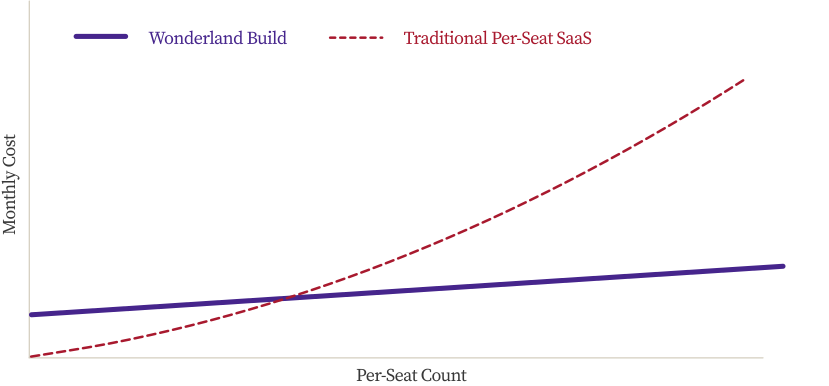
You get a finished system built around your business — not a bill that grows every time you hire.
Adam Bledsoe

Amanda berry

Shahla Mahdavi

FAQs
Custom operational tools for your business — dashboards, workflow interfaces, and API integrations — built inside the systems your business already runs on. Not a new platform to learn, not another login. It's software shaped around how your team actually works. We also build Google Workspace Add-ons and Chrome Extensions.
Your company does. You own the design, the data, and the source code.
That’s the whole point.
Most builds fail on adoption, not code.
We start with interviews and workflow mapping before anything gets written, and we design for the people who have to open the thing every morning. You also work directly with the three people doing the work. There's no account layer in between.
No. AI is how we build faster than a shop our size otherwise could. It isn't something you have to adopt, staff for, or manage. You get a finished system and the training to run it, and nobody on your team becomes an AI specialist.
Most ERPs give you infrastructure without a usable interface. We often extend what you already have rather than replacing it, so you keep your system of record and lose the shadow spreadsheets built around it.
You choose how hands-on you want to be — we offer a monthly maintenance retainer if you'd rather we keep it running, or we can train someone on your team to navigate and troubleshoot the backend themselves. Either way, nothing stops working the day you decide not to.
Mid-market, roughly. Big enough that the SaaS bill compounds and the workflows are real, small enough that a large consultancy is the wrong tool for the job.
Contact us
Custom dashboards, workflow interfaces, and API routing, built inside the architecture your business already pays for. No seat licenses. No compounding bill. No one else holding the keys.
Let's start a conversation.
For general inquires, fill out this form.
If you're interested in a free discovery call,